ONE LAST QUESTION

Kyle Thiermann’s new book dares to propose that our lives are shaped less by the answers we’ve been carrying and more by the questions we’re brave enough to ask

By Brian Upton
November 23, 2025
Share:

“Questions are invitations to see our parents in the present tense, and a declaration that we care about the wisdom of elders in a culture obsessed with youth.”

Kyle Thiermann

Santa Cruz is a town built on connection — lineups that become family, neighborhoods that look after each other, and a creative ecosystem where someone always knows someone who can help you find your footing. We’re good at community in the public sense: checking in, showing up, sharing waves, supporting the scene.

But there’s one angle we don’t always follow through on — the stories inside our own homes.
The quiet histories.
The questions we’ve never asked the people who raised us.

That’s where Kyle Thiermann’s new book, One Last Question Before You Go, hits with the weight of a soft but undeniable call to action. It asks this famously connected town to look inward for a moment — to the mothers, fathers, step-parents, and elders whose stories we’ve lived next to our entire lives without ever fully hearing them.

From the jump, Kyle carries that rare blend of groundedness and curiosity — like the air around him slows just enough for the conversation to deepen without effort. It’s not performance; it’s presence. Maybe it comes from living close to the ocean, to risk, to stories, and to questions many of us quietly avoid.

He grew up straddling two worlds after his parents split — half his time on the Westside, half on the Eastside. “I could go over and surf the Lane for half the week,” he told me, “and then go surf Pleasure Point for the other half.”

Two breaks, one kid, always moving. He laughed, remembering it: “Geographically not very far away, but really they are two different cultures… and even more so when I grew up.”

Before the surf career, before the writing, before the book, he was a skate rat at The Fun Spot — the old wharf-side skatepark that shaped a generation of Santa Cruz kids. Somewhere between skate ramps, the Lane, and Pleasure Point, a storyteller was forming.

His earliest films were lo-fi surf spoofs with friends — CKY-era chaos mixed with Jackass-level creativity. But the storytelling itch kept evolving. He wrote pieces for Outside, SURFER, and the Discovery Channel, reporting everywhere from Chilean Indigenous conflicts to ecological mysteries in Hawaii. His creative work eventually shaped campaigns for Patagonia, Yeti, and MUD\WTR — billboards above LAX, viral videos seen by millions.

But the medium that changed everything wasn’t film or journalism — it was the podcast.

Kyle’s podcast, The Kyle Thiermann Show, now spans more than 400 episodes with guests ranging from Dr. Peter Attia to Mick Fanning to astrophysicists, sex therapists, and educators. And through all those conversations, he realized something unsettling:

“Most of us were taught that asking questions makes you look stupid,” he said. “But it’s the opposite. Asking questions is a portal into the unknown.”
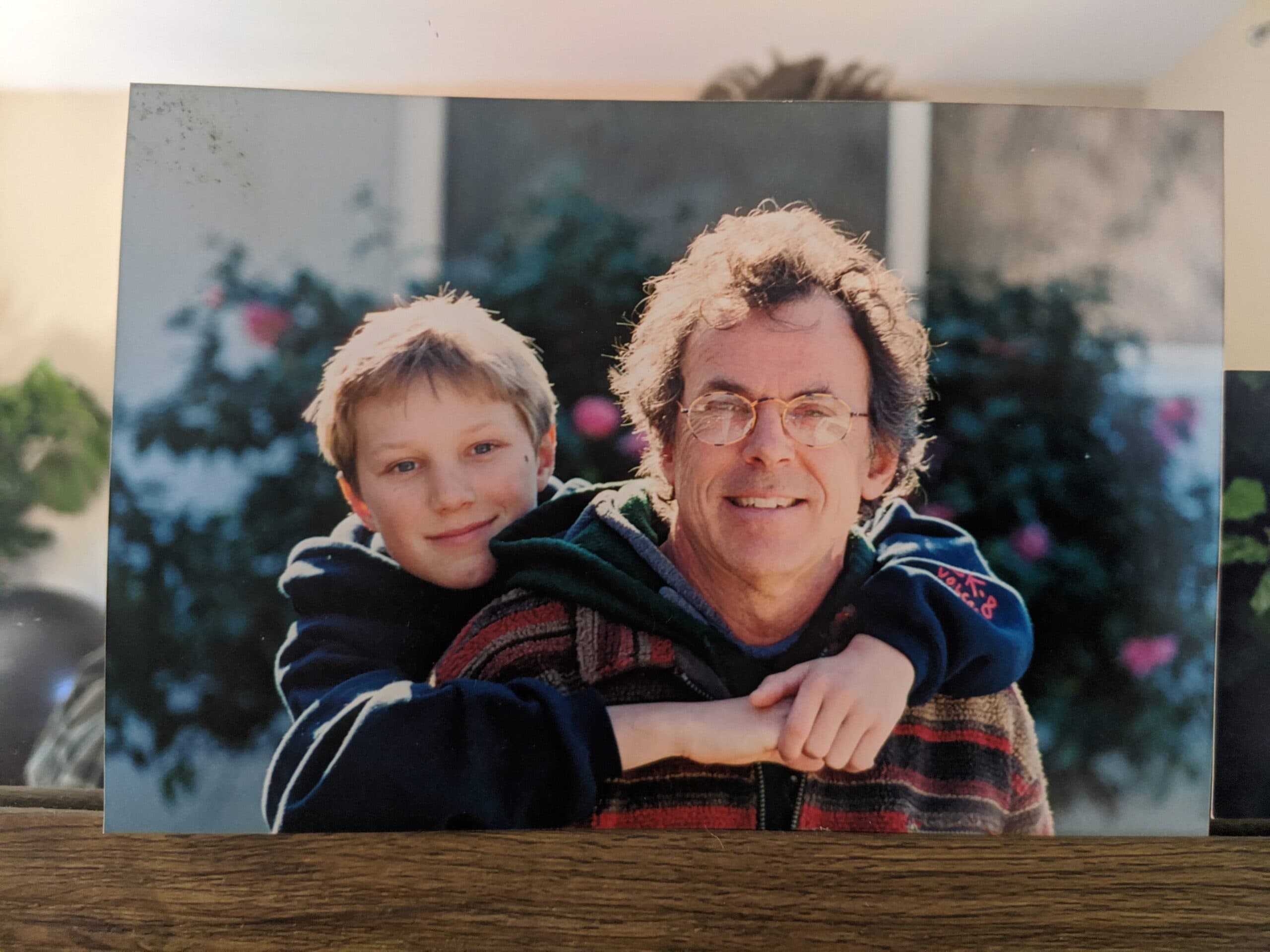
Ironically, he realized he was good at asking deep questions everywhere except where it mattered most — at home.

That truth revealed itself during a podcast interview with his dad, Eric, a documentary filmmaker, eccentric thinker, flea-market negotiator who loved the game more than the deal. The conversation was lively, revealing, and fun. But the email the next morning hit with unexpected weight:

“Hey, thanks for having me on your podcast. It made me feel like what I had to say was important.”

Kyle sat with that for a long time.

“I had spent all this time getting good at asking people questions, but I had never turned that skill around and asked my parents any questions,” he said.

That sentence became the seed of One Last Question Before You Go.

But it wasn’t connected to a sense of urgency until life made it urgent.

Two years after that podcast, Kyle’s mother was helping a friend back out of a parking garage. The gate arm came down unexpectedly, slamming onto her head and breaking her hip and femur.

“She’s in her mid-70s,” he said. “A broken hip is often the first domino that leads to death.”

Time suddenly felt finite.

Kyle realized how many stories from his mother’s life he only half-understood. If she’d died, whole eras — Berkeley protests, early adulthood, the messy victories and private defeats — would’ve vanished with her. So he began asking questions, real ones. Specific ones. Ones rooted in curiosity rather than convenience.

Photo by Ryan Craig. Mavericks, California

Her perspective gave him a kind of ballast as he interviewed his parents — a reminder that fear, love, grief, and curiosity can all exist in the same conversation.

What surprised Thiermann most was how much grief surfaced during the interviews — not later, not after, but during the interviews themselves. He realized early on that sitting across from a parent with a recorder running brings mortality into the room, whether anyone names it or not. As he put it, part of the tension comes from the unspoken truth that “you’re doing this because, in part, they’re going to die and you want this to be around later”.

He didn’t shy away from that discomfort. He moved toward it.

Throughout the writing of the book, he stayed in close touch with a hospice nurse — “the most comfortable person with death of anyone I’ve ever met”. She reminded him that death is not a taboo subject; it’s simply part of being human. Her perspective gave him a kind of ballast as he interviewed his parents — a reminder that fear, love, grief, and curiosity can all exist in the same conversation.

But on the other side of all that heaviness was something unexpected — a steadiness.

“Having done this, I’m more prepared for my parents’ death than I would have been,” he said. “It is a stoic, memento mori–style practice that allows you to act better around them in the future.”

That line isn’t morbid.
It’s mature.
It’s the kind of emotional adulthood most of us never name out loud.

And Kyle’s clarity here feels like the deeper heartbeat of the entire project: interviewing your parents isn’t just about preserving stories — it’s about preparing your heart. It’s about grieving in small, honest increments now so you’re not crushed all at once later. It’s about presence, not fear; intimacy, not avoidance.

In a culture that rushes past anything uncomfortable, Kyle chose to sit in it — and came out the other side more human for it.

“It’s amazing what we don’t remember… until we’re asked about it specifically.”

He interviewed his mom, his dad, his stepdad.
He asked about the moments between the milestones.
He asked about fears, beliefs, mistakes, hopes, contradictions — all the things that make a person human beyond the role of “parent.”

He traveled the country in his ’97 Ford RV — Starflight — meeting memory researchers, hospice nurses, communication experts, and writers. Every conversation helped him understand not just the mechanics of memory, but the emotional architecture of identity.

One idea hit particularly hard: we don’t remember the original events of our lives — we remember the last time we told the story.

Every retelling reinforces who we believe we are.

Kyle realized which stories he’d been cementing — and how many stories he’d never bothered to ask his parents to tell.

As he dug deeper, interviewing them became less about archiving their lives and more about recalibrating his own. With his mom, long-standing political tension softened as he re-met the young activist who marched through Berkeley in 1970. With his dad, he discovered quiet depths of meaning behind simple statements that might have slipped past him years ago.

It wasn’t easy work.

“Interviewing your parents is like a psychedelic trip,” says Thiermann. “It’s useful for most, life-changing for some — but not for everyone. You don’t leave it going ‘Woohoo!’ You leave it like, ‘Whoa… gnarly.’”

“One idea hit particularly hard: we don’t remember the original events of our lives — we remember the last time we told the story.”

And somewhere in the middle of all this inquiry, something else surfaced: a cultural critique.

“We’re a culture obsessed with youth,” he said. “We put all the attention on people who don’t know anything yet.”

His book pushes back — gently but directly — insisting that wisdom still matters, that elders still hold the map, and that curiosity is one of the purest forms of love.

Writing the book became its own discipline. Kyle treated it like athletic training — timer set, distractions removed, draft after draft after draft. He’d hand-copy pages of David Sedaris to internalize rhythm and humor. He transformed old resentments into material, using the alchemy of narrative to turn painful truths into something almost — unbelievably funny.

And in doing so, he found a deeper understanding of his parents. Of himself. Of the stories that raise us, haunt us, protect us, and limit us.

As our conversation wound down, I kept thinking about how one honest question can shift years of emotional gravity. Interviewing your parents won’t instantly heal old wounds. It won’t rewrite history. But it creates a new space between you — a space big enough for truth to breathe.

And truth, when given a little room, can change a relationship entirely.

One Last Question Before You Go isn’t really about death, though mortality quietly shapes its edges. It’s about perspective — about seeing the people who shaped us as full, complicated humans. It’s about recognizing that identity is built story by story. And it’s about the courage it takes to ask questions that may change what we think we know.

Thiermann says you don’t need a whole weekend or a perfectly lit moment. You just need to start. A car ride. A walk. Five questions. The smallest opening is often all it takes.

In a fast culture that moves on quickly, forgets easily, and worships the next thing,  One Last Question Before You stands as a reminder that wisdom isn’t a trending topic — it’s a lineage. That memories are alive. That stories evolve.

As a complete work, the book dares to propose that our lives are shaped less by the answers we’ve been carrying and more by the questions we’re finally brave enough to ask.


One Last Question Before You Go

Book Tour Stop

Tuesday November 25, 2025 

Patagonia Santa Cruz

More Info: https://onelastquestion.splashthat.com/

Listen to the full Vibes Drop In interview:

Share: